Contact Lens Fitting in Da Lat — What Foreigners Need to Know Before Buying Lenses

You walk into an optical shop somewhere in Southeast Asia, point at a box of contact lenses, and hope for the best. Maybe the power matches your glasses prescription. Maybe the base curve is close enough. Maybe the lenses will sit on your eyes without sliding, drying out, or blurring your vision after two hours.
That approach works until it doesn’t. And when it doesn’t, you’re left with irritated eyes, wasted money, and a box of lenses you can’t return — all because you skipped a proper contact lens fitting in Da Lat or wherever you happened to buy them.
Contact lenses are not one-size-fits-all. Unlike glasses that sit 12 millimeters away from your eyes, contacts rest directly on your cornea. The curvature of your eye, the diameter of your iris, your tear film quality, and even your blinking habits all affect which lens works for you. Getting this wrong doesn’t just cause discomfort — it can lead to corneal abrasion, chronic dryness, or infections that derail your trip.
This guide covers everything foreigners need to know about getting a proper contact lens fitting in Da Lat — from understanding the measurements involved to finding a shop that does it right.
Why Does Contact Lens Fitting Matter More Than You Think?
A proper contact lens fitting determines whether your lenses sit correctly on your cornea, provide clear vision, allow adequate oxygen flow, and remain comfortable throughout the day. Skipping this step is the single biggest reason travelers end up with contact lens problems abroad.
Your cornea has a specific curvature, measured as the base curve (BC). If the lens base curve is too flat for your eye, the lens slides around with every blink, causing blurred vision and irritation. If the base curve is too steep, the lens grips your cornea too tightly, restricting oxygen flow and potentially causing redness, swelling, or worse — corneal neovascularization, where blood vessels grow into the normally clear cornea to compensate for oxygen deprivation.
At Dang Phuoc Quan Eyewear, the opticians have measured base curves ranging from 8.0 to 9.2 mm across thousands of customers over 30 years. Most Asian eyes fall between 8.4 and 8.8 mm, while many Western eyes run between 8.5 and 9.0 mm. Grabbing a random box off the shelf — which typically comes in 8.5 or 8.6 mm — means a coin flip on whether the lens actually fits your eye.
Beyond base curve, your tear film quality matters. Some people produce fewer tears or have tears that evaporate quickly. Contact lens fitting in Da Lat at a professional shop includes assessing how your eyes handle lens wear — information that determines whether you need a high-moisture daily lens or a silicone hydrogel monthly lens with better oxygen transmission.
What Happens During a Professional Contact Lens Fitting?
A complete contact lens fitting involves measuring your corneal curvature, converting your glasses prescription for contact lens use, and testing actual lenses on your eyes to verify comfort and vision. This process takes roughly 30 to 45 minutes and eliminates the guesswork that causes most contact lens problems.
Here’s exactly what each step involves.
Base Curve and Diameter Measurement
The optician uses a keratometer or autorefractor with keratometry function to measure the curvature of your cornea. This reading, expressed in millimeters (like 8.4 mm or 8.6 mm), determines the base curve your contact lens needs.
Your corneal diameter is also measured — typically between 11.5 mm and 12.5 mm — to ensure the contact lens covers your cornea properly without being too large or too small. A lens that’s too small won’t center correctly. A lens that’s too large interferes with natural tear exchange beneath the lens.
At Dang Phuoc Quan Eyewear at 31 Nguyen Van Cu, Da Lat, these measurements are taken with the same professional autorefractor used for glasses prescriptions. The machine captures both readings simultaneously, giving the optician precise data to select your lens parameters. After more than three decades of serving both local and international customers, the team has refined this process to handle the full range of eye shapes foreigners present.
Power Conversion from Glasses to Contacts
Your glasses prescription and your contact lens prescription are not identical. Glasses sit approximately 12 mm in front of your eyes, while contact lenses sit directly on the cornea. This vertex distance changes the effective power of the lens.
For prescriptions above +/-4.00 diopters, the difference becomes significant. A glasses prescription of -5.00 might translate to a contact lens power of -4.75. At -8.00, the contact lens equivalent could be -7.25. The optician calculates this conversion using a standard vertex distance formula — not guesswork.
If you have astigmatism (CYL on your glasses prescription), the situation gets more complex. Mild astigmatism under -0.75 can sometimes be absorbed into the spherical contact lens power. Higher astigmatism requires toric contact lenses, which have a specific axis orientation that must match your prescription. Getting contact lens fitting in Da Lat from a qualified optician means this conversion is done accurately, preventing the blurred vision and headaches that come from approximate corrections.
Trial Lens Assessment
After measurements and calculations, the optician places trial contact lenses on your eyes. This is the step most shops skip — and the step that matters most.
With trial lenses in, the optician checks several things. First, lens movement: a properly fitted lens should move about 0.5 to 1.0 mm with each blink. Too much movement means the base curve is too flat. Too little movement means it’s too steep. Second, centration: the lens should sit centered over your pupil, not drifting nasally or temporally. Third, comfort: after 10 to 15 minutes of wear, the lens should feel natural — not scratchy, dry, or like you’re constantly aware of something on your eye.
At Dang Phuoc Quan, trial lenses from multiple brands are kept in stock specifically for this fitting process. The English-speaking staff walks you through each observation, explaining what they’re checking and why, so you understand the reasoning behind their final lens recommendation.

What Types of Contact Lenses Are Available in Da Lat?
Da Lat optical shops carry daily disposables, monthly lenses, toric lenses for astigmatism, and multifocal lenses for presbyopia. Availability varies by shop, but established stores stock the most commonly requested types from international brands.
Daily disposable lenses are the most popular choice for travelers. You wear a fresh pair each day and discard them at night — no cleaning solution, no lens case, no risk of buildup or infection from extended wear. Brands like Acuvue 1-Day Moist and Bausch + Lomb Biotrue ONEday are widely available. For contact lens fitting in Da Lat, daily lenses are often the first recommendation for foreigners who want convenience and hygiene during travel.
Monthly lenses offer better value for longer stays. You wear the same pair for up to 30 days, cleaning and storing them each night in multipurpose solution. Acuvue Oasys, Bausch + Lomb Ultra, and Air Optix Aqua are common options. Monthly silicone hydrogel lenses allow more oxygen to reach your cornea than older hydrogel materials — important in Da Lat’s climate, where altitude and dry air can accelerate lens dehydration.
Toric lenses correct astigmatism and are available in both daily and monthly formats. These lenses have a specific orientation marker that must align with your astigmatism axis. Fitting toric lenses requires extra precision during the trial lens step, because the lens must stabilize in the correct position on your eye. Not every optical shop in Da Lat carries a full range of toric parameters, but Dang Phuoc Quan stocks common toric prescriptions and can order specific parameters within a few days.
Multifocal contact lenses serve travelers over 40 who need both distance and near vision correction. These are less commonly stocked in Da Lat, but they can be ordered through authorized distributors. If you need multifocal contacts, mentioning this during your contact lens fitting in Da Lat helps the optician plan accordingly and check availability before you commit.
How Is a Contact Lens Prescription Different from Glasses?
A contact lens prescription includes all the parameters of a glasses prescription — sphere (SPH), cylinder (CYL), and axis for astigmatism — plus base curve (BC), diameter (DIA), and brand-specific details that ensure the physical lens fits your eye correctly.
Here’s a practical comparison. A glasses prescription might read: SPH -4.50, CYL -1.25, AXIS 170. The corresponding contact lens prescription could read: SPH -4.25, CYL -1.25, AXIS 170, BC 8.5, DIA 14.2, Brand: Acuvue Oasys for Astigmatism. Notice the sphere power changed from -4.50 to -4.25 due to vertex distance conversion. The CYL and AXIS remain the same because the toric lens corrects astigmatism at the corneal plane.
You cannot use your glasses prescription to buy contact lenses directly — this is a mistake many travelers make. The power differences, combined with the physical fit parameters (BC and DIA), mean contact lenses must be prescribed specifically for contact lens wear. A proper prescription glasses exam and a contact lens fitting are two separate processes, even when done at the same shop on the same visit.
This distinction is especially important when ordering contacts online. Without a valid contact lens prescription — one that includes BC, DIA, and the correct converted power — you’re gambling with your eye health. Professional contact lens fitting in Da Lat gives you a prescription you can use confidently, whether buying in-store or ordering online later.
Where Can Foreigners Get Contact Lens Fitting in Da Lat?
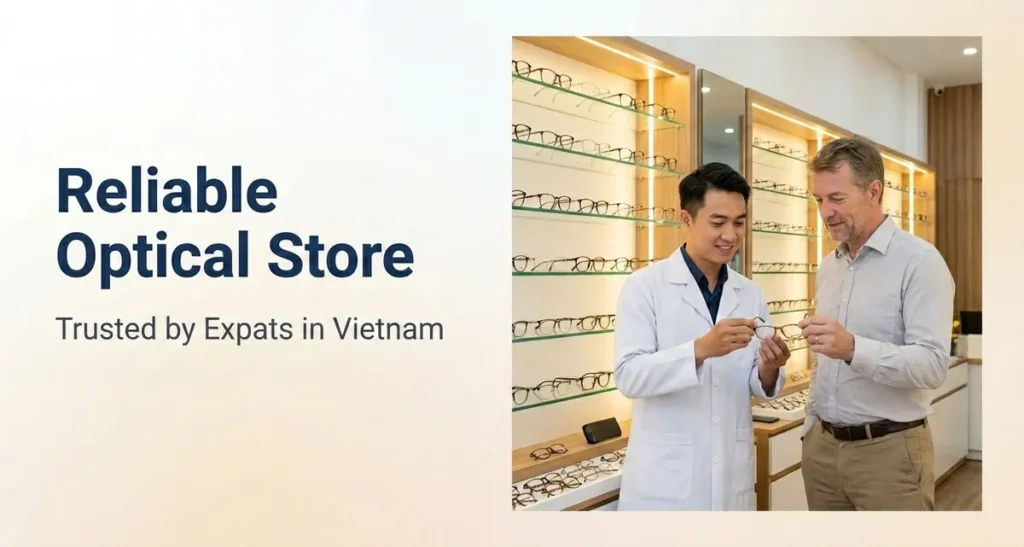
Foreigners should choose an optical shop with keratometry equipment, trial lens inventory, and staff experienced in serving international customers. For reliable contact lens fitting in Da Lat, Dang Phuoc Quan Eyewear at 31 Nguyen Van Cu has the equipment and experience to handle the full fitting process.
Three factors make this shop the practical choice for foreigners needing contacts.
First, the equipment. Base curve measurement requires a keratometer or an autorefractor with keratometry capability. Not every optical shop in Da Lat has this — many smaller shops sell contact lenses by simply asking your glasses power and handing you a box. Dang Phuoc Quan’s autorefractor measures both refraction and corneal curvature in a single scan, providing the data needed for an accurate lens fit.
Second, trial lens availability. A proper fitting requires placing actual lenses on your eyes to verify the fit. This means the shop needs trial lenses in multiple base curves, powers, and brands. Stocking trial lenses is an investment that only shops committed to proper fitting maintain. At Dang Phuoc Quan, the trial lens collection covers the range needed for most fitting scenarios.
Third, communication. Contact lens fitting involves more patient interaction than buying glasses — the optician needs to understand your wearing habits, screen time, dry eye symptoms, and comfort preferences. The English-speaking staff at Dang Phuoc Quan can discuss these factors directly, ensuring nothing gets lost in translation. This is the same team that handles comprehensive eyewear fitting for glasses, bringing the same thoroughness to contact lens consultations.
What Should First-Time Contact Lens Wearers Know?
If you’ve never worn contacts before, the fitting appointment includes insertion and removal training, care instructions, and a wearing schedule to build up your tolerance gradually. First-time wearers need more guidance than experienced users, and getting your first contact lens fitting in Da Lat at a professional shop ensures you start with the right habits.
The most common fear — touching your eye — is entirely normal. The optician will demonstrate the insertion technique, then guide you through doing it yourself. Most first-timers succeed within 10 to 15 minutes. The trick is pulling your lower lid down with one finger while holding the lens on your opposite index finger, looking slightly upward, and placing the lens on the white part of your eye below the pupil.
Removal is usually easier. Pinch the lens gently between your thumb and index finger while looking upward. If the lens feels stuck, add rewetting drops and blink several times — it will loosen.
For your first week, limit wear to 4 to 6 hours per day, gradually increasing to 8 to 12 hours by the second week. This lets your eyes adapt to having a foreign object on the cornea. If you experience persistent redness, pain, or vision changes after removing lenses, return to the best optician for a follow-up check.
Daily disposables are strongly recommended for first-time wearers. They eliminate the learning curve of cleaning and storage, reduce infection risk, and let you try contact lens wear without committing to a monthly lens care routine. If you discover contact lenses aren’t for you, you’ve only invested in a small pack of dailies rather than a full month’s supply plus solutions.
Common Mistakes Foreigners Make When Buying Contacts Abroad
After years of fitting contact lenses for international visitors, Dang Phuoc Quan’s opticians consistently see the same mistakes. Avoiding these saves you discomfort, money, and potential eye health issues.
Buying contacts based on glasses power alone. As explained above, the powers differ due to vertex distance. This mistake is most costly for people with prescriptions above -4.00 or below +4.00, where the conversion changes the power by 0.25 to 0.75 diopters. That fraction of a diopter translates directly to blurred vision.
Ignoring base curve entirely. Many travelers buy contacts from convenience stores or pharmacies that sell one-base-curve-fits-all lenses. If your eyes happen to match that base curve, you’re lucky. If they don’t, you’ll experience sliding, discomfort, or restricted oxygen — problems that worsen over days of continuous wear.
Wearing monthly lenses beyond 30 days. Extended wear degrades the lens material, increases protein deposits, and raises infection risk significantly. The 30-day timeline starts when you open the blister pack, not when you accumulate 30 days of actual wearing time. Some travelers try to stretch a monthly pair across two months of intermittent use — this is unsafe regardless of how few days you actually wore them.
Sleeping in lenses not approved for overnight wear. Unless your specific lens is FDA-approved for extended (overnight) wear, removing contacts before sleep is mandatory. Sleeping in standard contacts reduces corneal oxygen by up to 80%, creating conditions for bacterial keratitis — a painful infection that can scar your cornea permanently.
Skipping the fitting because “I already know my prescription.” Your eyes change over time, and a prescription from two years ago may no longer be accurate. More importantly, your base curve and diameter never appear on a glasses prescription. Every contact lens fitting in Da Lat should include fresh measurements, even if you’ve worn contacts before.
Frequently Asked Questions About Contact Lens Fitting in Da Lat
How much does contact lens fitting cost?
At Dang Phuoc Quan Eyewear, the fitting examination is included free when you purchase contact lenses. The lenses themselves vary by type and brand — daily disposables typically cost 200,000 to 500,000 VND ($8 to $20 USD) per box of 30 lenses, while monthly lenses range from 150,000 to 400,000 VND ($6 to $16 USD) per pair. Toric and multifocal options cost more due to their specialized design.
Can I get same-day contacts?
For standard spherical lenses in common powers, yes — most are available in stock for immediate purchase. Toric lenses with specific axis and cylinder combinations, or unusual powers, may require ordering and typically arrive within 2 to 5 business days.
Should I bring my glasses prescription?
Absolutely. Your glasses prescription provides a valuable starting point, even though the contact lens prescription will differ. It speeds up the fitting process and gives the optician a baseline to compare against their own measurements. If you’ve had a recent optical service exam elsewhere, bring those results too.
Can I wear contacts during outdoor activities in Da Lat?
Yes, with precautions. Daily disposable lenses are ideal for activities like hiking, canyoning, or motorbike riding because you discard them afterward — no need to worry about cleaning dirt or debris from the lens. Avoid wearing contacts in natural water (waterfalls, hot springs) due to acanthamoeba risk. If water contact is likely, switch to daily disposables and discard them immediately after the activity.
What if the first pair doesn’t fit well?
This is exactly why trial lens assessment exists. If the initial lens choice causes discomfort, excessive movement, or blurred vision, the optician will try a different base curve, diameter, or brand. A proper contact lens fitting in Da Lat includes this iterative process — you don’t leave until the fit is right.
—
Contact lenses open up freedom that glasses can’t match — no fogging in Da Lat’s cool mornings, no frames bouncing during mountain hikes, no peripheral vision limitations on winding highland roads. But that freedom depends entirely on getting the right fit.
A professional contact lens fitting in Da Lat at Dang Phuoc Quan Eyewear, 31 Nguyen Van Cu, means your lenses are matched to your corneal curvature, your prescription is accurately converted from glasses, and your comfort is verified with actual trial lenses before you commit. With over 30 years of optical expertise and English-speaking staff ready to guide you through the process, your eyes are in experienced hands.
Liên Hệ Ngay Để Trải Nghiệm Không Gian Mua Sắm Kính Mát Tuyệt Vời Nhất Đà Lạt
Mắt Kính Đặng Phước Quân — Nơi bạn tìm thấy sự khác biệt trong từng sản phẩm kính mắt.
- Địa chỉ: 31 Nguyễn Văn Cừ, Phường Xuân Hương — Đà Lạt
- Hotline: 0925 331 668
- Email: [email protected]
- Fanpage: Mắt Kính Đặng Phước Quân Đà Lạt
- Goolemap: https://maps.app.goo.gl/7KNZr7v82PAKAKb47