


Eye Prescription Translation in Vietnam — How Local Opticians Read Your Foreign Rx
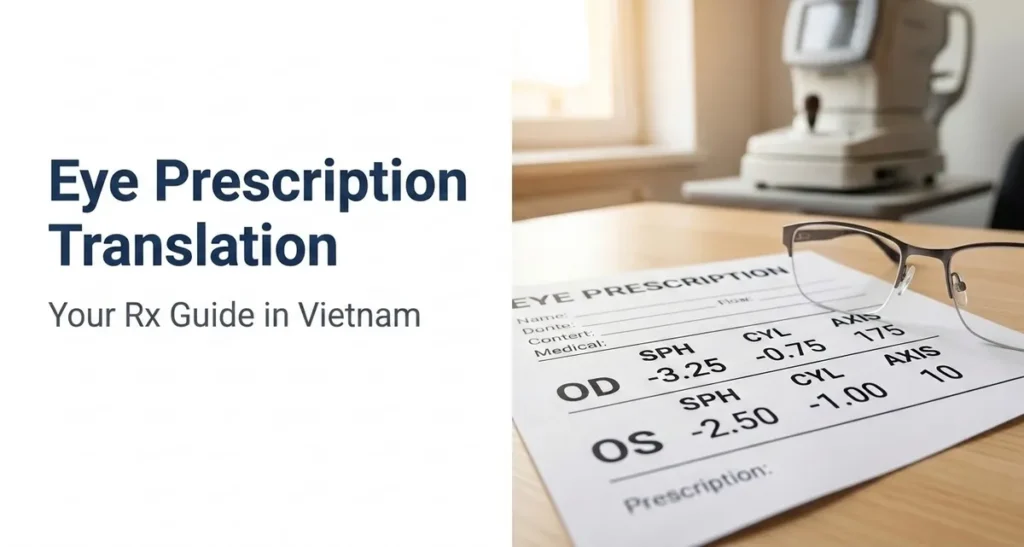
Eye Prescription Translation in Vietnam — How Local Opticians Read Your Foreign Rx
You’re holding an eye prescription from your optometrist back home — maybe from the US, the UK, or Australia — and you need new glasses while traveling through Vietnam. The paper is covered with abbreviations: SPH, CYL, AXIS, ADD, PD. You know your doctor explained it once, but that conversation happened six months and four countries ago. Now you’re standing in a Vietnamese optical shop, wondering whether anyone here can actually read this thing.
The short answer: yes. Eye prescription translation in Vietnam is something that experienced opticians handle routinely, especially in tourist-friendly cities like Da Lat. The longer answer — and the reason this guide exists — is that prescription formats vary between countries in ways that matter, and understanding what your numbers mean puts you in control of the entire process.
This guide breaks down every value on your prescription, explains how Vietnamese opticians interpret foreign formats, and shows you exactly what to expect when getting your Rx filled at a local shop.
Why Does Your Foreign Prescription Need Translation?
Eye prescriptions follow an international standard for core values — SPH, CYL, AXIS, ADD, and PD are universal abbreviations used by optometrists worldwide. The “translation” isn’t about language. It’s about format differences, notation conventions, and additional information that varies from country to country.
An American prescription might list values in negative cylinder notation. A British prescription from an NHS optometrist might use positive cylinder format. An Australian prescription might include additional visual acuity notes that Vietnamese opticians don’t typically record. These differences are small but meaningful — and getting eye prescription translation in Vietnam right means understanding each one.
The practical challenge for most expats and travelers is simpler than the technical details. You hand over a piece of paper with numbers on it and you need confidence that the person reading it will produce lenses that match your eyes. At Đặng Phước Quân Eyewear in Da Lat, the staff reads US, UK, and Australian prescription formats daily — it’s a routine part of serving the city’s international visitors and expat community. But understanding your own prescription gives you an extra layer of assurance.
What Do the Numbers on Your Eye Prescription Mean?
Before diving into format differences between countries, you need to understand what each value on your prescription actually represents. This knowledge is essential for anyone seeking eye prescription translation in Vietnam, because it lets you verify that your new glasses match your original Rx.
SPH (Sphere) — Your Distance Correction
SPH is the primary number on any eye prescription. It indicates how much correction your eyes need for distance vision. A negative SPH (like -2.50) means you’re nearsighted — you see close objects clearly but distant ones are blurry. A positive SPH (like +1.75) means you’re farsighted — distant objects are clearer than close ones.
SPH is measured in diopters and moves in 0.25 increments: -1.00, -1.25, -1.50, -1.75, -2.00, and so on. This standard applies universally, regardless of which country issued your prescription. If your American prescription reads SPH -3.25 for your right eye, a Vietnamese optician interprets it identically — no conversion needed for this value.
One detail that trips some people up: if your SPH reads “Plano” or “Pl,” it means zero correction for sphere. Your eye doesn’t need distance adjustment, but you may still need lenses for astigmatism or reading.
CYL (Cylinder) and AXIS — Astigmatism Values
CYL measures the degree of astigmatism in your eye — a condition where the cornea isn’t perfectly round, causing light to focus unevenly. AXIS tells the optician the angle (from 1 to 180 degrees) at which the astigmatism correction needs to be placed on the lens.
These two values always appear together. If your prescription has CYL but no AXIS, or vice versa, something is missing — flag it with your optician before proceeding.
Here’s where eye prescription translation in Vietnam gets slightly technical. Astigmatism can be written in two different notations:
Negative cylinder notation: Used by most optometrists in the United States, Canada, and Australia. The CYL value is negative (e.g., CYL -0.75).
Positive cylinder notation: Used by many ophthalmologists and some optometrists in the UK, parts of Europe, and some Asian countries. The CYL value is positive (e.g., CYL +0.75).
Both notations describe the exact same eye condition — they’re just different ways of expressing it mathematically. A trained Vietnamese optician can convert between these systems instantly using a standard transposition formula. At Đặng Phước Quân, the staff regularly converts between negative and positive cylinder when reading foreign prescriptions — it takes about ten seconds with a calculator and changes nothing about the final lens.
PD (Pupillary Distance) — The Critical Measurement
PD is the distance between the centers of your pupils, measured in millimeters. It’s arguably the most important measurement for comfortable glasses, yet it’s the one most often missing from foreign prescriptions.
American prescriptions frequently omit PD because optometrists there assume you’ll have it measured separately at whatever optical shop fills your lenses. UK prescriptions may or may not include it. Australian prescriptions usually do.
Average adult PD ranges from 58 to 68mm. It can be written as a single number (e.g., PD: 63) or split for each eye (e.g., 31/32, measured from the center of your nose to each pupil).
Why does PD matter so much? Because the optician uses it to align the optical center of each lens with your pupil. If PD is wrong by more than 2mm, you’ll experience eye strain, headaches, and a constant feeling that something is “off” about your new glasses.
If your prescription doesn’t include PD — and many foreign prescriptions don’t — any reputable Vietnamese optical shop will measure it for you on the spot using a digital PD meter or manual pupillometer. This is standard practice and takes less than a minute.
ADD (Addition) — For Reading and Multifocal Lenses
ADD appears on prescriptions for people who need multifocal or progressive lenses — typically those over 40 experiencing presbyopia (age-related difficulty focusing on close objects). It represents the additional magnification needed for near vision, layered on top of your distance prescription.
ADD values are always positive (e.g., +1.50 or +2.25) and usually identical for both eyes. The format for ADD is consistent across all countries — this value requires no conversion during eye prescription translation in Vietnam.
If your prescription doesn’t include ADD and you’re under 40, that’s entirely normal. If you’re over 40 and your prescription lacks ADD but you’re struggling to read menus or phone screens, mention it to the optician during your visit. They can test your near vision separately.

How Do Vietnamese Opticians Read Foreign Prescriptions?
At a professional optical shop, the process of reading your foreign prescription follows a consistent verification approach. This is how eye prescription translation in Vietnam works in practice at an experienced shop like Đặng Phước Quân.
First, the optician reads your prescription values directly. Since SPH, CYL, AXIS, ADD, and PD use the same abbreviations worldwide, the numbers transfer without language translation. Your American “-3.25 SPH” means exactly the same thing in Vietnam as it does in New York.
Second, the optician checks the cylinder notation. If your prescription uses positive cylinder and the shop’s system uses negative cylinder (or vice versa), they perform a quick transposition. This is a standard mathematical conversion — not a judgment call — and the result is optically identical.
Third, and this is where experienced shops distinguish themselves, the optician cross-references your foreign prescription against their own measurements. At Đặng Phước Quân, every foreign prescription goes through their 12-step examination process for verification. This isn’t about doubting your home optometrist — it’s about catching changes that may have occurred since your last exam, confirming the prescription under current conditions, and ensuring PD accuracy.
This verification step catches problems more often than you’d expect. Prescriptions older than 12 months may no longer match your current vision. Travel fatigue, altitude changes, and different lighting conditions can temporarily affect refraction results. And occasionally, a prescription simply has a transcription error from the original clinic.
The 12-step process at Đặng Phước Quân includes autorefractor scanning, manual refraction with trial lenses, dominant eye testing, binocular balance, and precise digital PD measurement. For anyone getting eye prescription translation in Vietnam, this verification provides peace of mind that your new glasses will be accurate — not just a copy of numbers from a paper that might be outdated.
What Are the Common Format Differences Between Countries?
Understanding these differences helps you anticipate questions your Vietnamese optician might ask. Here’s what varies by country of origin.
United States prescriptions typically use negative cylinder notation, list OD (right eye) before OS (left eye), and frequently omit PD. They often include visual acuity scores (like 20/20) which Vietnamese opticians don’t need for lens fabrication but may reference for context.
United Kingdom prescriptions may use either positive or negative cylinder notation, depending on whether an optometrist or ophthalmologist wrote them. NHS prescriptions sometimes include a “prism” value for binocular vision issues. UK formats occasionally abbreviate differently — “Sph” instead of “SPH” — but the meaning is identical.
Australian prescriptions generally follow negative cylinder notation, similar to the US format. They tend to be more complete, often including PD and sometimes additional notes about lens recommendations. Australian prescriptions are among the easiest for Vietnamese opticians to read directly without any conversion.
Other formats occasionally seen in Vietnam include prescriptions from Singapore (typically very detailed, negative cylinder), Japan (may use different abbreviation styles but the same underlying values), and various European countries (positive or negative cylinder depending on the practitioner’s training).
At Đặng Phước Quân, the staff has handled prescriptions from over a dozen countries over the years. Converting between notation systems is second nature — the optical math is universal even when the formatting is not.
How Does Đặng Phước Quân Handle Foreign Prescriptions?
For travelers and expats seeking reliable eye prescription translation in Vietnam, Đặng Phước Quân Eyewear at 31 Nguyễn Văn Cừ, Da Lat has built specific processes around international prescriptions.
Staff members read prescriptions in US, UK, and Australian formats without hesitation. The shop’s optical equipment — including an autorefractor valued at over 1 billion VND — provides independent verification measurements to cross-reference against your brought-in Rx.
Every foreign prescription gets the same 12-step examination process used for local customers. The optician walks you through any discrepancies between your original Rx and their measurements, explaining each difference in English before you approve the final prescription for lens fabrication.
SPH, CYL, Axis, PD, and ADD are each explained in plain English during the consultation. If your home prescription uses positive cylinder and the shop’s system uses negative, the optician shows you both notations side by side so you can see they describe the exact same correction.
This level of care matters because prescription glasses are only as good as the prescription behind them. A slightly off CYL axis or a missed PD measurement can turn a perfectly ground lens into a headache machine. For anyone getting eye prescription translation in Vietnam, thorough verification eliminates that risk entirely.
The shop also retains your prescription data on file, so if you return to Da Lat later or need a replacement pair shipped, your Rx is already stored and ready.
What Should You Bring to Make the Process Easier?
Preparation takes five minutes and saves significant time at the shop.
Bring your written prescription — paper or digital. A photo on your phone works perfectly. Make sure the image is clear enough to read all values, including any small print or footnotes your doctor may have added.
Bring your current glasses, even if they’re damaged. A lensometer can read the prescription directly from existing lenses in seconds. This provides a quick verification baseline and is especially useful if your written prescription is outdated or hard to read.
If you have a contact lens prescription, bring it separately. Contact lens and eyeglass prescriptions differ — the contact lens Rx includes base curve and diameter values not found on a glasses prescription, and the SPH power may differ slightly due to vertex distance correction.
Know when your last eye exam occurred. If your prescription is more than 18 months old, expect the optician to recommend a fresh exam. Vision changes gradually, and a prescription that was perfect a year ago may need fine-tuning after extended travel.
For the smoothest experience getting eye prescription translation in Vietnam, visit an eyeglasses shop that regularly serves international customers. Shops accustomed to foreign prescriptions handle format conversion and verification as part of their standard workflow — you won’t need to explain the process because they’ll guide you through it.
Frequently Asked Questions
Can any optical shop in Vietnam read my foreign prescription?
Most professional shops can read the core values (SPH, CYL, AXIS) since these are internationally standardized. However, handling cylinder notation conversion, verifying with independent measurements, and explaining results in English requires real experience with international patients. For reliable eye prescription translation in Vietnam, choose a shop with a track record of serving expats and tourists — like the best optician options in Da Lat that handle foreign Rx daily.
Do I need a new eye exam, or can the shop just fill my existing prescription?
You can have your existing prescription filled directly without a new exam. However, experienced shops strongly recommend a verification exam, especially if your Rx is older than 12 months. The verification catches vision changes, confirms PD accuracy, and ensures the prescription reflects your current needs. At most shops offering optical service to tourists, the verification exam is included free with any lens purchase.
What if my prescription is written in a language other than English?
Prescription values are numerical and use Latin abbreviations (SPH, CYL, OD, OS) that remain the same worldwide. Even a prescription written entirely in Japanese, Korean, or German can be read by a Vietnamese optician — the numbers and abbreviations transcend language barriers. The only potential issue is handwriting legibility, which is a universal problem regardless of country.
How long does it take to get glasses made from a foreign prescription?
For standard single-vision lenses with common parameters, expect 2-4 hours from verified prescription to finished glasses. High-index lenses, progressives, or specialty coatings may require 1-3 business days depending on stock. Visit early in the day and communicate your travel timeline so the shop can plan accordingly.
Is there an extra charge for reading a foreign prescription?
No reputable shop charges extra for reading or converting a foreign prescription. The consultation, cylinder transposition, and PD measurement are standard parts of the eyewear service for tourists. You pay only for your frames and lenses at the same prices offered to local customers.
—
Getting your foreign eye prescription filled in Vietnam doesn’t require luck — it requires choosing the right shop. The numbers on your Rx are universal, the conversion between notation systems is straightforward, and experienced opticians handle these translations daily.
Đặng Phước Quân Eyewear at 31 Nguyễn Văn Cừ, Da Lat brings over 30 years of optical expertise to every prescription they read — foreign or local. Their 12-step verification process, ability to convert between any notation system, and English-speaking staff make eye prescription translation in Vietnam a simple, transparent experience. Bring your prescription, and let the professionals handle the rest.
Practical keyword consistency note
eye prescription translation in vietnam should be reviewed regularly to keep daily vision stable and comfortable.
Liên Hệ Ngay Để Trải Nghiệm Không Gian Mua Sắm Kính Mát Tuyệt Vời Nhất Đà Lạt
Mắt Kính Đặng Phước Quân — Nơi bạn tìm thấy sự khác biệt trong từng sản phẩm kính mắt.
- Địa chỉ: 31 Nguyễn Văn Cừ, Phường Xuân Hương — Đà Lạt
- Hotline: 0925 331 668
- Email: [email protected]
- Fanpage: Mắt Kính Đặng Phước Quân Đà Lạt
- Goolemap: https://maps.app.goo.gl/7KNZr7v82PAKAKb47
Bài viết cùng chủ đề:
-

Gọng Kính TR90 vs Nhựa Thường — Chênh Giá Có Đáng Với Độ Bền?
-
Tròng Kính Kodak — Review Chi Tiết Và Bảng Giá Tại Đà Lạt
-
Zeiss DuraVision — Phân Tích Chi Tiết Các Dòng Lớp Phủ Cao Cấp
-

Dòng Tròng Hoya — Review Chi Tiết Thương Hiệu Nhật Bản
-
Hướng Dẫn Chọn Tròng Kính Từ A-Z — Cho Người Mới Bắt Đầu
-
So Sánh 3 Thương Hiệu Tròng Kính Hàng Đầu
-

Dòng Tròng Zeiss — Review Chi Tiết Công Nghệ Quang Học Đức
-

Vision Test for Foreigners in Da Lat — What to Expect From a 12-Step Professional Eye Exam
-

Comprehensive Eye Exam in Vietnam — What to Expect and Why It Matters
-

Professional Optometry Services in Vietnam — What Foreigners Need to Know Before Their First Eye Exam
-

Tròng Kính Essilor — Review Chi Tiết Thương Hiệu Số 1 Thế Giới
-
So Sánh Đầy Đủ Các Dòng Lớp Phủ Crizal — Sapphire, Rock, Prevencia, Easy UV
-

Tròng Kính Trivex — Chất Liệu Cao Cấp Ít Người Biết Đến
-

Tròng Có Phủ vs Không Phủ — So Sánh Thực Tế Sau 1 Năm Sử Dụng
-

Tròng Kính Polycarbonate — Lựa Chọn An Toàn Cho Trẻ Em Và Người Chơi Thể Thao
-

Độ Cận Độ Viễn — 4 Điều Khách Hàng Hay Hiểu Sai Khi Đọc Đơn Kính

