


No products in the cart.
Vision Test for Foreigners in Da Lat — What to Expect From a 12-Step Professional Eye Exam

Vision Test for Foreigners in Da Lat — What to Expect From a 12-Step Professional Eye Exam
You’ve been traveling through Vietnam for weeks, and something isn’t right with your vision. Maybe your current prescription feels outdated after months of screen time in co-working spaces across Southeast Asia. Perhaps you’ve noticed persistent headaches on Da Lat’s winding mountain roads. Or you simply want to take advantage of Vietnam’s affordable healthcare to get a proper eye exam — something you’ve been putting off back home because of cost or scheduling hassle.
Whatever your reason, getting a vision test for foreigners in Da Lat is straightforward, professional, and surprisingly thorough. The exam process at established optical shops matches — and in some ways exceeds — what you’d experience at a mid-range optometry clinic in the US, UK, or Australia. The difference is the price (a fraction of what you’d pay at home), the convenience (no appointment needed), and the speed (walk in any day of the week).
This guide walks you through the complete 12-step eye examination process at Đặng Phước Quân Eyewear, located at 31 Nguyễn Văn Cừ, Da Lat, so you know exactly what to expect before you step through the door.
Why Should You Get a Vision Test While Visiting Da Lat?
Foreigners seek vision tests in Da Lat for practical reasons — outdated prescriptions, broken glasses, or taking advantage of Vietnam’s affordable optical care. A proper vision test for foreigners in Da Lat takes about 20-30 minutes, costs nothing when paired with a lens purchase, and delivers results as accurate as clinics in major Western cities.
Three situations drive most foreign visitors to seek a vision test for foreigners in Da Lat.
The most common is an outdated prescription. Extended travel changes your visual habits — more screen time in cafes, stronger sun exposure at 1,500 meters elevation, different reading distances on buses and trains. If your last eye exam was over a year ago, your prescription may no longer match your actual visual needs. Travelers frequently discover their headaches and eye strain aren’t from travel fatigue — they simply need updated lenses.
The second reason is replacing lost or broken glasses. Da Lat is an adventure destination with canyoning, mountain biking, and motorbike tours through highland passes. Glasses get damaged, and having a complete vision test ensures your replacement pair is based on current measurements rather than an old prescription scribbled on a card from two years ago.
The third is cost savings. A comprehensive eye exam in the United States typically costs $100-$250 without insurance. In Da Lat, the same quality exam is included free with any prescription glasses purchase. For digital nomads and long-term travelers, scheduling a vision test for foreigners in Da Lat while you’re already here is one of the smartest healthcare decisions you can make on the road.
What Does the 12-Step Professional Eye Examination Include?
The 12-step eye examination at Đặng Phước Quân Eyewear goes beyond a basic “read the chart” test. Every vision test for foreigners in Da Lat at this shop follows the same rigorous protocol used for local patients — no shortcuts, no simplified version for visitors in a hurry. Each step builds on the previous one to create a complete picture of your visual health.
Here is exactly what happens at each stage, explained so you know what to expect even before you arrive.
Steps 1 Through 4 — Patient History and Automated Measurements
Step 1: Patient history and visual complaint assessment. The optician asks about your current glasses or contacts, any visual complaints (headaches, blurred vision, difficulty with night driving), your occupation (screen work, outdoor activities), and any eye conditions in your family. English-speaking staff handles this conversation naturally — no translation app needed.
Step 2: Visual acuity test. You read a standardized letter chart (Snellen chart) at a set distance, first without glasses and then with your current correction if you have one. This establishes your baseline visual performance and shows the optician exactly how well — or poorly — you’re currently seeing.
Step 3: Autorefraction measurement. This is where the premium equipment matters. The autorefractor — a machine valued at over 1 billion VND (approximately $40,000 USD) — scans each eye in seconds. You look at a target inside the machine, it takes multiple readings, and it produces an objective measurement of your refractive error. This machine eliminates guesswork and gives the optician a precise starting point. The equipment at Đặng Phước Quân is comparable to what you’d find in established optical clinics across major cities worldwide.
Step 4: Retinoscopy. The optician uses a retinoscope — a handheld instrument that shines light into your eye — to observe how light reflects off your retina. This provides an independent objective measurement to cross-check the autorefractor results. It’s particularly useful for detecting irregularities that automated machines sometimes miss.
Steps 5 Through 8 — Subjective Refraction and Binocular Testing
Step 5: Subjective refraction with trial lenses. This is the “better one or better two” part of the exam that most people recognize. The optician places a trial frame on your face and swaps lenses while you report which option gives clearer vision. This step fine-tunes the autorefractor’s objective reading with your subjective visual experience. A skilled optician can refine your prescription to within 0.25 diopters of your optimal correction.
Step 6: Astigmatism axis and power determination. If the autorefractor detected astigmatism (and roughly 30-40% of patients have it), this step determines the exact axis and power of your cylindrical correction. Using a cross-cylinder technique, the optician rotates lenses to find the angle where your vision is sharpest. Getting this wrong means blurry vision and headaches — which is why a thorough vision test for foreigners in Da Lat matters more than a quick automated reading alone.
Step 7: Binocular vision and balance test. Your eyes need to work together as a team. The optician tests both eyes simultaneously to ensure the prescribed correction allows comfortable binocular vision. An imbalance between the two eyes can cause depth perception problems and fatigue, even if each eye tests perfectly on its own.
Step 8: Dominant eye test. Everyone has a dominant eye — the one your brain prefers for detailed visual tasks. The optician identifies your dominant eye because this information affects lens recommendations, especially for progressive (multifocal) lenses or specialized sport eyewear. Knowing which eye is dominant helps optimize your prescription for your real-world visual habits.
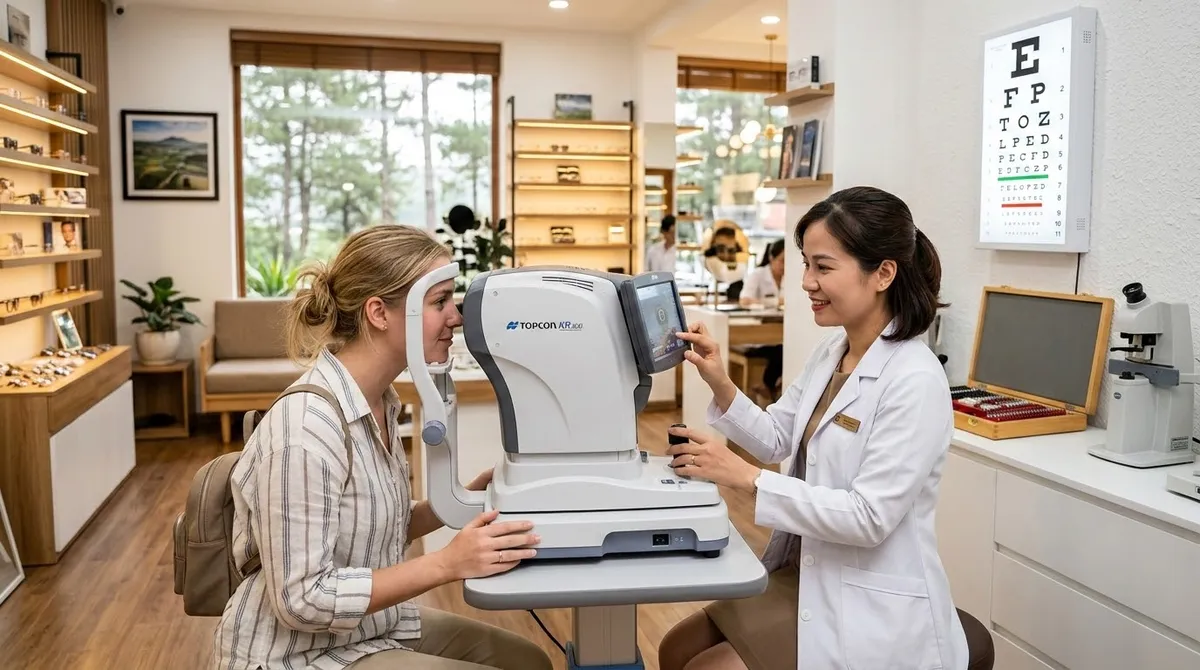
Steps 9 Through 12 — Fine-Tuning, Measurements, and Final Verification
Step 9: Near vision assessment. If you’re over 40 or report difficulty reading up close, the optician tests your near vision to determine whether you need reading correction (ADD power). This involves reading a near-point card at a comfortable distance while the optician adjusts supplementary lenses. Even if you came in thinking you only need distance glasses, this step may reveal early presbyopia you hadn’t noticed.
Step 10: Pupillary distance (PD) measurement. Using a digital pupillometer, the optician measures the exact distance between your pupils — typically 58-68mm for adults. This measurement is critical because it determines where the optical center of each lens should sit. A PD error of just 2mm can cause eye strain, headaches, and a vague sense that your new glasses “feel wrong.” Digital PD measurement eliminates the guesswork of manual ruler-based methods.
Step 11: Lens simulation and recommendation. Before you commit to a prescription, the optician lets you experience your corrected vision through trial lenses in a real-world scenario — looking across the room, reading your phone, and checking intermediate distances. They also recommend specific lens types (single-vision, progressive, photochromic) based on your lifestyle. English-speaking staff at Đặng Phước Quân explains every recommendation in detail so you understand exactly what you’re getting and why.
Step 12: Final prescription verification and documentation. The optician reviews the complete prescription with you — SPH, CYL, AXIS, ADD (if applicable), and PD for each eye. They compare results with your previous prescription if you brought one. Any discrepancies are explained clearly. You receive a printed prescription card with all measurements — an international-format document that any optician worldwide can read.
How Does the Equipment Compare to Western Eye Clinics?
The equipment at Đặng Phước Quân matches what you’d find at quality eye clinics in Western countries. The quality of your vision test for foreigners in Da Lat depends entirely on equipment caliber, and this shop invests at a level that most independent opticians in Western cities don’t match. Their premium autorefractor is valued at over 1 billion VND and the precision lens edging machine at 790 million VND — these are not corner-shop instruments.
This matters because equipment determines measurement accuracy. A premium autorefractor captures multiple readings per second and averages them to eliminate inconsistencies caused by blinking or eye movement. Budget machines take one reading and call it done. The difference shows up in your final prescription — and in how comfortable your glasses feel during 14-hour travel days.
The lens edging machine (valued at 790 million VND, approximately $32,000 USD) shapes your lenses to fit your chosen frame with micrometer precision. For travelers who need their glasses to survive months of backpack living, this precision prevents edge chipping, improper fit, and coating damage that plague cheap lens cutting.
Can Foreigners Get a Vision Test Without Speaking Vietnamese?
Language is the biggest concern for foreigners getting an eye exam in Vietnam, but at shops experienced with international visitors, it’s a non-issue. Your vision test for foreigners in Da Lat at Đặng Phước Quân is conducted with clear English communication at every stage — from describing your symptoms to explaining each result on your prescription card.
The eye exam component of a vision test for foreigners in Da Lat is largely universal. You respond with “one or two,” “better or worse,” “clearer or blurrier” — the same responses used in optometry offices from Sydney to London. Visual acuity charts use standardized letters and numbers. Equipment readings are numerical and internationally formatted.
What sets this shop apart is the explanation phase. After the exam, the optician walks you through your results in English — what your prescription means, how it compares to your previous one, why certain lens types are recommended for your situation, and what to expect when adapting to new glasses. With over 30 years of experience serving both locals and international visitors, the staff replaces the anxiety of staring at numbers you don’t understand with genuine clarity about your visual health.
What Should You Bring to Your Eye Exam?
Three things help make your vision test for foreigners in Da Lat faster and more accurate.
Bring your current glasses — even if damaged. The lens fragments contain your current prescription data, which an optician can read instantly using a lensometer. This speeds up your exam and provides a reliable baseline for comparison with your new measurements.
Bring any existing prescription documents — or a photo on your phone. The shop can work from foreign prescriptions for comparison. The format (SPH, CYL, AXIS, ADD, PD) is standardized internationally, so any qualified optician can read a prescription issued in any country. Having your old prescription allows the optician to cross-reference their measurements and explain any differences.
If you wear contact lenses, remove them at least 2-4 hours before your exam (ideally the night before). Contacts temporarily reshape your cornea, and testing while that reshaping is still active can produce inaccurate measurements.
Do You Need an Appointment, or Can You Walk In?
No appointment is needed. Đặng Phước Quân Eyewear welcomes walk-in customers — locals and foreigners alike — during regular business hours. This is standard practice for optical service providers in Da Lat, where the culture favors flexibility over rigid scheduling. You can simply show up, request a vision test for foreigners in Da Lat, and the process begins within minutes.
For travelers on tight schedules, visiting in the morning provides the most flexibility. If you need prescription glasses made the same day, arriving before 10 AM gives the lab maximum processing time. But even afternoon visits are perfectly fine for the exam itself — your prescription results are immediate.
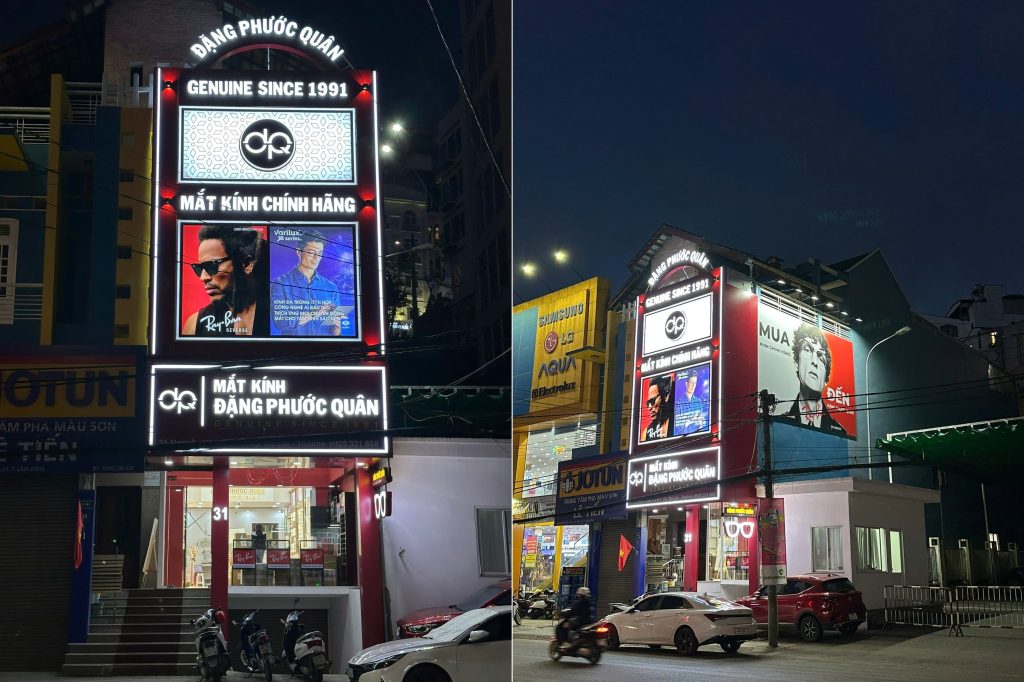
The shop is located at 31 Nguyễn Văn Cừ, Da Lat, in the central ward near the main market area. It’s accessible from virtually any hotel or hostel in the city center — a 5-minute motorbike ride or 15-minute walk from the Da Lat Night Market.
How Much Does a Vision Test Cost for Foreigners?
The professional 12-step eye examination is complimentary when you purchase lenses — no separate exam fee, no hidden charges, and the same price applies whether you’re a local or a tourist. This makes getting a vision test for foreigners in Da Lat one of the best value propositions in Southeast Asian travel healthcare.
For the glasses themselves, expect to pay between 500,000 VND and 5,000,000 VND ($20-$200 USD) for a complete pair, depending on your frame and lens choices. Mid-range options with branded frames and high-index lenses typically run 1,500,000-3,000,000 VND ($60-$120 USD). Premium combinations pairing Ray-Ban or Oakley frames with Essilor or Zeiss lenses range from 3,000,000-8,000,000 VND ($120-$320 USD).
Compared to Western prices — where an exam alone costs $100-$250 USD, frames start at $150, and quality lenses add another $200-$400 — the total cost in Da Lat represents savings of 60-80% on equivalent authentic products from authorized brands.
Frequently Asked Questions
How accurate is a vision test at a Da Lat optical shop compared to my home country?
For standard refractive errors — nearsightedness, farsightedness, astigmatism, and presbyopia — the accuracy matches quality clinics worldwide. The determining factor is equipment quality, not geographic location. A premium autorefractor at a Da Lat eyeglasses shop delivers identical precision to the same model in a London or New York practice. However, if you suspect eye disease, glaucoma, or retinal issues, seek a specialized ophthalmologist rather than an optical shop.
Can I use my foreign prescription to get glasses made without a new exam?
Yes. Any reputable optical shop can work from your existing foreign prescription — the format is standardized internationally. However, getting a fresh exam allows the optician to verify your prescription against current measurements. This comparison is free when you purchase lenses, and many travelers discover their prescription has changed since their last test.
Is the exam process different from what I’d experience at home?
The core process is identical — autorefraction, subjective refraction, visual acuity, PD measurement. The main difference is personal attention. At Đặng Phước Quân, the best optician in Da Lat with 30 years of experience personally conducts every vision test for foreigners in Da Lat using the same 12-step protocol. In large Western chain stores, you might see a different technician at each stage. The other difference is turnaround — same-day glasses here versus the 7-14 day wait common in many Western optical shops.
What if I only want sunglasses with my prescription?
Prescription sunglasses follow the same vision test process. After determining your prescription, the optician helps you choose a suitable sunglass frame and recommends lens options — polarized, photochromic (Transitions), or fixed tint. At Da Lat’s 1,500-meter elevation, UV protection is especially important, and prescription sunglasses built from your accurate exam results provide both clear vision and proper eye protection.
Can children get vision tests here?
Yes. The 12-step examination works for children, though the optician adapts communication for younger patients. For children under 8, a hospital eye clinic with cycloplegic refraction (using eye drops to relax the focusing muscles) may provide more accurate results. For older children and teenagers, the shop exam is reliable and comprehensive.
—
Getting a vision test doesn’t have to wait until you return home. A vision test for foreigners in Da Lat at Đặng Phước Quân Eyewear — 31 Nguyễn Văn Cừ — delivers over 30 years of optical experience, premium equipment worth over 1 billion VND, and genuine English-language service throughout the complete 12-step process. Every eyewear service for tourists follows the same thorough protocol, ensuring your prescription is as accurate as anything you’d receive at a premium clinic back home. Walk in any day, no appointment needed, and leave with a clear understanding of your vision — along with a printed prescription you can use anywhere in the world.
Ghé Mắt Kính Đặng Phước Quân
Nếu cần hỏi thêm hoặc muốn đo mắt, thử kính trực tiếp, bạn có thể gọi trước hoặc ghé cửa hàng.
- Địa chỉ: 31 Nguyễn Văn Cừ, Phường Xuân Hương, Đà Lạt
- Điện thoại: 0925 331 668
- Giờ mở cửa: 09:00–21:00 hằng ngày
- Chỉ đường: Xem trên Google Maps
- Liên hệ: Trang Liên hệ
Xem thêm:
Bài viết cùng chủ đề:
ZEISS DuraVision Benefits, Coatings & Price Guide
Essilor vs Zeiss: Which Lenses Are Better?
handmade acetate frames in da lat: Smart Buyer Tips
Hoya vs Chemi lenses comparison guide
essilor vs zeiss lenses price in Vietnam guide

Chemi lenses price in Vietnam: 2026 buying guide
Find a Kodak lens authorized dealer in Vietnam
Authentic Zeiss Lenses in Vietnam Buying Guide
Transitions Gen 8 lenses in Da Lat: guide & prices

Hoya Blue Control Lenses in Da Lat Guide

Carl Zeiss Vision Lenses in Vietnam Guide
Essilor Crizal lenses in Da Lat buying guide

Anti Meaning, Uses, and SEO Guide
Anti Meaning: Definition, Uses, and Examples

What Is Scratch? Beginner Guide for Kids
Hydrophobic lens coating in Vietnam buyer guide


