


No products in the cart.
high index lenses 1.67 1.74 in Vietnam guide
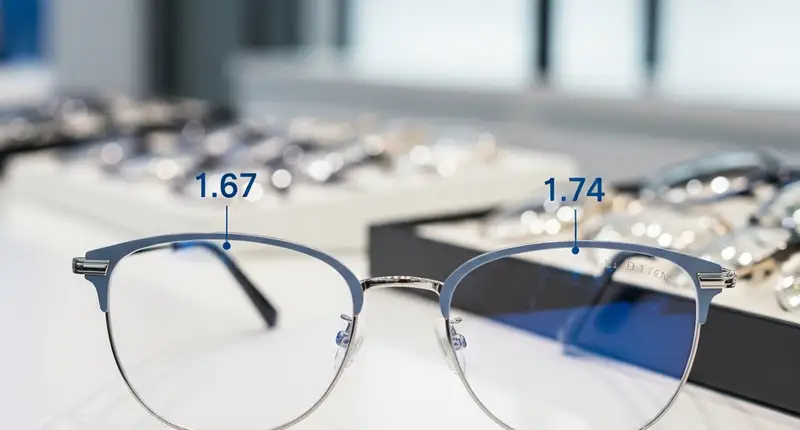
If you are comparing high index lenses 1.67 1.74 in Vietnam, you are probably trying to solve a very practical problem: your current lenses feel too thick, too heavy, or they do not look the way you want in the frame you like. In 2026, with more lens choices available across Vietnam, knowing when to choose 1.67 and when to move up to 1.74 can save you money and improve everyday comfort.
High index lenses 1.67 1.74 in Vietnam explained

When you shop for thinner lenses, the numbers can feel confusing at first. But once you understand what lens index means and how it affects thickness, appearance, and price, it becomes much easier to decide which option actually fits your prescription and your budget.
What high-index lens numbers actually mean
Lens index refers to how efficiently a lens material bends light. The higher the number, the less material is needed to achieve the same prescription, so the lens can be made thinner.
That is why high index lenses 1.67 1.74 in are commonly recommended for stronger prescriptions. Compared with standard 1.50 or 1.56 lenses, both 1.67 and 1.74 can reduce visible edge thickness, especially for myopia.
In simple terms, 1.74 is thinner than 1.67, and 1.67 is thinner than 1.56. But thickness is not the whole story, because clarity, reflections, frame size, and price also matter.
Why 1.67 and 1.74 are the most compared options
In Vietnam, these two indexes are often compared because they sit in the sweet spot for people with medium-high to very high prescriptions. If your prescription is mild, you may not need either one.
If your myopia starts around -4.00D and goes upward, high index lenses Vietnam shops recommend will often include 1.67. Once you move into stronger prescriptions such as -7.00D, -8.00D, or more, 1.74 enters the conversation more often.
Based on real-world experience, many buyers compare these two because they want thinner eyeglass lenses Vietnam opticians can supply without jumping blindly into the most expensive option. You want a visible improvement, but you also want value.
A higher index does not automatically mean a better wearing experience. In some cases, 1.67 gives you a smarter balance of thickness, optical quality, and cost.
Who should read this Vietnam lens comparison
This guide is for you if you have high myopia, a stronger prescription with astigmatism, or if you simply want a slimmer and lighter pair of glasses. It is also useful if you are changing frames and want to avoid thick lens edges.
If you are searching for the best lenses for high myopia, or if you are asking nên chọn tròng 1.67 hay 1.74, this comparison is designed for exactly that decision. It focuses on what matters in daily use, not just marketing claims.
1.67 lens vs 1.74 lens: key differences that matter
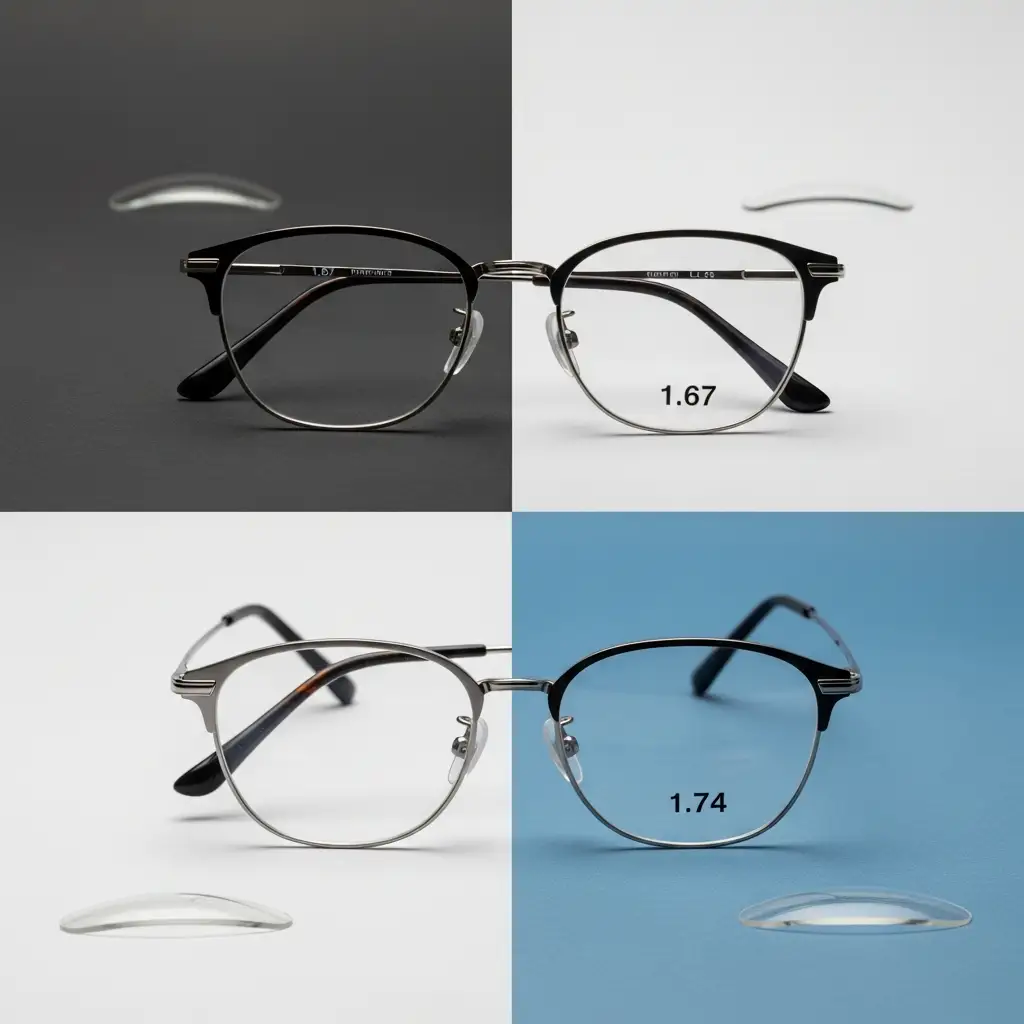
At first glance, the difference may seem simple: 1.74 is thinner. But when you actually wear the glasses every day, you notice more than just thickness, including edge shape, reflections, comfort, adaptation, and how much more you are paying for each extra millimeter saved.
Thickness and edge profile in strong prescriptions
For minus lenses, most of the visible thickness sits at the edge. That means frame size and shape can dramatically change how thick your glasses look.
In practice, a 1.74 lens may reduce edge thickness by roughly 5% to 15% compared with 1.67, depending on prescription, lens diameter, and frame choice. For some users, that difference is clearly visible. For others, it is noticeable only when placed side by side.
If you wear something like -6.00D in a small round frame, 1.67 may already look very neat. If you wear -9.00D in a larger rectangular frame, 1.74 can make a more meaningful cosmetic difference.
Visual clarity, Abbe value, and chromatic aberration
Higher-index materials usually have a lower Abbe value, which can increase chromatic aberration. That means you may notice more color fringing or slightly less comfortable peripheral vision, especially if you are sensitive.
This is one reason some people prefer 1.67 lens vs 1.74 lens for daily wear when the prescription allows. The thinner profile of 1.74 is appealing, but the visual trade-off can matter.
Many users report that center vision feels excellent in both, while the difference appears more toward the edges. If you are detail-sensitive or spend long hours on screens, this is worth discussing with your optician.
Is this difference huge? Usually not. But if you are paying premium pricing, small differences become important.
Weight, comfort, and frame balance
Thinner does not always mean dramatically lighter. High-index materials can have different densities, and the total weight of your glasses also depends on lens size, frame weight, and coating package.
Still, when your prescription is strong, reducing edge bulk can improve how the frame sits on your face. That matters if your glasses slide down your nose or feel front-heavy.
Based on real-world experience, wearers with prescriptions above -8.00D often notice that 1.74 feels cleaner and more balanced in lighter frames. But if your frame is already compact, the comfort gain over 1.67 may be modest.
Price differences in Vietnam optical stores
Price is where the decision becomes more practical. In Vietnam, the jump from 1.67 to 1.74 is often significant, especially with premium anti-reflective coatings or branded lens designs.
The exact gap varies by store, brand, coating, and whether the lens is stock or custom ordered. In many cases, 1.74 can cost 20% to 60% more than 1.67.
That is why high index lenses 1.67 1.74 in comparisons should never focus on thickness alone. You should ask whether the visual and cosmetic gain is large enough to justify the extra cost in your specific prescription.
Which prescriptions benefit most from each lens index
The smartest choice depends less on the number printed on the sample card and more on how your actual prescription behaves in your chosen frame. Prescription strength, astigmatism, PD, and lens diameter all affect the final result more than many buyers expect.
When 1.67 is usually enough for daily wear
If your prescription falls roughly in the range of -4.00D to -7.00D, 1.67 is often the practical choice. It usually offers a clear improvement over standard materials without pushing cost too high.
If you choose a smaller or medium-size frame, 1.67 may already give you thin eyeglass lenses Vietnam buyers would consider attractive for daily office wear. That is especially true when paired with aspheric design.
In practice, many people with moderate to moderately high myopia buy 1.67 and never feel they should have paid more for 1.74. This is one of the most common “good value” decisions in optical stores.
When 1.74 makes more sense for very high myopia
If your prescription is above about -8.00D, especially with added astigmatism, 1.74 becomes much more compelling. The edge thickness savings are often easier to see and more useful cosmetically.
This is particularly true if you prefer rimless, semi-rimless, or thin metal frames where lens thickness is more exposed. In those cases, tròng kính chiết suất cao 1.74 can help the final pair look more refined.
Many users report that 1.74 feels worth it when the lens edge would otherwise dominate the frame. If you are looking for the best lenses for high myopia, this is the range where 1.74 often earns its premium.
If your prescription differs greatly between the two eyes, higher index can also help reduce the cosmetic imbalance between lenses.
Why frame shape can change the best choice
A large frame can make even a premium lens look thick. A smaller frame can make a lower index look surprisingly slim.
This is why high index lenses 1.67 1.74 in buying decisions should always include frame selection. A 48 mm frame can outperform a 54 mm frame in visible thinness, even if both use the same index.
As a rule, rounder and smaller shapes usually reduce edge thickness for myopia better than wide rectangular or oversized styles. So before paying more for 1.74, check whether a better frame shape could solve most of the problem.
How thin eyeglass lenses in Vietnam really compare
Most shoppers want a simple answer: which one is thinner. The reality is more nuanced, because lens design, frame measurements, and fitting can change the outcome enough that two people with similar prescriptions may get very different cosmetic results.
Why smaller frames can make lenses look thinner
Lens thickness increases as you move away from the optical center. So the farther the edge sits from your pupil, the thicker that edge can become.
That means a smaller eye size usually helps more than people expect. Reducing frame width by just a few millimeters can create a visible difference, especially in minus lenses.
In practice, this is one of the cheapest ways to improve lens appearance. Instead of paying only for a higher index, you may get better results by choosing a more compact frame first.
How aspheric and atoric designs improve appearance
Aspheric lenses flatten the front curve and help reduce the “bulging” look of strong prescriptions. They can also improve appearance by reducing eye minification somewhat.
Atoric designs go further, especially for stronger prescriptions with astigmatism, by improving optics across more of the lens surface. If you are comparing high index lenses 1.67 1.74 in offers, this design detail matters.
Many users focus only on index and forget lens design. But an aspheric 1.67 can sometimes look and perform better than a basic 1.74.
Center thickness and edge thickness explained
For minus lenses, the center is relatively thin and the edge becomes thicker. For plus lenses, it is the opposite.
Because of that, people with myopia should pay close attention to edge thickness estimates, not just index labels. Ask the store to show you expected thickness based on your actual prescription and frame.
Here’s what most people miss:
Two 1.74 lenses from different brands may not look identical. Design choices, minimum thickness standards, and lab processing all affect the finished result.
Tròng kính chiết suất cao 1.67 và 1.74 có gì khác
Nếu bạn đang tìm kiếm theo tiếng Việt, điều bạn cần không chỉ là tròng nào mỏng hơn mà còn là tròng nào hợp với độ cận, gọng kính và ngân sách của bạn. Đây là phần giúp bạn hiểu rõ cách chọn theo thói quen mua kính thực tế tại Việt Nam.
Tròng kính chiết suất cao 1.67 phù hợp với ai
Tròng kính chiết suất cao 1.67 thường hợp với người cận trung bình đến cận khá cao, khoảng từ -4.00D đến -7.00D. Nếu bạn đeo kính mỗi ngày, làm việc văn phòng, học tập nhiều và muốn cân bằng giữa giá và độ mỏng, đây là lựa chọn rất phổ biến.
Tròng này thường cho cảm giác nhìn dễ chịu hơn mức 1.74 đối với một số người nhạy với quang sai màu. Đồng thời, giá cũng mềm hơn nên hợp với người muốn tối ưu chi phí.
Tròng kính chiết suất cao 1.74 phù hợp với ai
Tròng kính chiết suất cao 1.74 phù hợp hơn khi bạn cận rất cao, thường từ -8.00D trở lên, hoặc bạn muốn ưu tiên thẩm mỹ tối đa. Nếu bạn dùng gọng mảnh, gọng khoan hoặc gọng nửa viền, 1.74 thường đẹp hơn vì phần rìa tròng lộ ra ít hơn.
Tuy nhiên, giá sẽ cao hơn rõ rệt. Vì thế, tròng kính chiết suất cao 1.74 không phải lúc nào cũng là lựa chọn “đáng tiền” nhất nếu độ cận của bạn chưa đủ cao.
Nên chọn tròng 1.67 hay 1.74 theo độ cận
Nếu bạn đang băn khoăn nên chọn tròng 1.67 hay 1.74, hãy bắt đầu từ độ cận thực tế. Dưới khoảng -6.00D, nhiều trường hợp 1.67 là đủ đẹp nếu gọng không quá to.
Từ -6.00D đến -8.00D là vùng cần cân nhắc kỹ giữa thẩm mỹ và ngân sách. Trên -8.00D, đặc biệt có loạn hoặc chênh lệch hai mắt, 1.74 thường đáng cân nhắc hơn.
Dù vậy, 1.67 lens vs 1.74 lens vẫn không thể chốt chỉ bằng độ cận. Bạn nên xem thêm kích thước gọng và hỏi kỹ cửa hàng về độ dày mép tròng dự kiến.
Price guide for high index lenses in Vietnam
If you are trying to estimate giá tròng kính mỏng tại Việt Nam, the most useful approach is not to chase one fixed number. Prices vary widely by material, brand, coatings, custom surfacing, and whether you buy from a chain store, local optician, or premium boutique.
What affects lens pricing in Vietnam
The biggest factors are lens index, brand reputation, coating quality, and whether the lens is stock or made to order. Imported Japanese, German, or Korean brands often cost more than entry-level options.
Prescription complexity also matters. Higher astigmatism, prism correction, or special lens design can increase price beyond the index itself.
In 2026, it is common to see large price differences between stores for what seems like the “same” lens. That is why you should compare brand, coating package, warranty, and design, not just the quoted number.
Coatings that add value and cost
A premium anti-reflective coating is especially important for high index lenses 1.67 1.74 in prescriptions, because higher-index materials can reflect more light. Without a good AR coating, your lenses may look shinier and feel less comfortable in bright environments.
Hydrophobic, oleophobic, and anti-smudge layers also add cost, but many wearers find them worthwhile in Vietnam’s humid and dusty urban conditions. Scratch resistance and UV protection are often bundled, though not always equally well.
When premium 1.74 is worth paying for
Paying more for 1.74 makes sense when the visible thickness reduction is meaningful for your frame and prescription. This often happens in very high myopia, exposed-edge frame styles, or when appearance is a top priority.
Based on real-world experience, the premium is usually easier to justify when you wear your glasses full-time for 10 to 14 hours per day. If the benefit is only slight, 1.67 often gives better overall value.
How to compare quotes from optical shops
Ask each shop the same questions. What is the lens brand, actual index, lens design, coating type, warranty period, and estimated edge thickness in your chosen frame?
If a store cannot explain these clearly, be cautious. High index lenses Vietnam buyers choose should be evaluated by the finished result, not by the sales pitch.
Best coatings and add-ons for high myopia lenses
Once you choose the index, the coating package matters more than many people realize. For stronger prescriptions, the right coatings can improve lens appearance, reduce glare, make cleaning easier, and help your glasses stay comfortable in daily city use.
Anti-reflective coatings for clearer appearance
High-index lenses reflect more surface light than lower-index lenses. This is one reason your eyes may appear less visible behind the lenses if AR coating is poor.
A quality anti-reflective layer improves appearance and can reduce distracting reflections from screens, headlights, and indoor lighting. According to Wikipedia, higher-index materials often benefit strongly from anti-reflective treatment.
If you choose 1.74, premium AR is not optional in my view. It is one of the most important upgrades you can buy.
UV, water-repellent, and smudge-resistant options
UV protection is worth having, especially if you spend time outdoors. Water-repellent and oil-resistant coatings also help in hot, humid climates where lenses get dirty quickly.
Many users report that easy-clean coatings make a bigger daily difference than they expected. If you wear glasses all day, cleaning convenience matters.
Blue light filtering: useful or overhyped
Blue light filtering can be helpful for some users who spend long hours in front of digital screens, but it is not essential for everyone. The benefit is often overstated in sales conversations.
If screen glare bothers you, good AR coating and proper screen habits may help more. Blue filter is a personal add-on, not a universal requirement.
Do not let a shop distract you with trendy add-ons if the core lens design and fitting are weak. The basics matter first.
Lens design upgrades for stronger prescriptions
For strong myopia, aspheric or atoric designs are often more valuable than buyers expect. They can improve edge appearance, reduce lens bulge, and support better cosmetic results.
If you are comparing high index lenses 1.67 1.74 in different stores, ask whether the lens is spherical, aspheric, or atoric. That one detail can change both looks and comfort.
Common buying mistakes when choosing thinner lenses
A lot of disappointment comes not from choosing the wrong brand, but from focusing on the wrong factor. Many buyers pay for premium index and still end up unhappy because frame choice, measurements, and adaptation were ignored.
Choosing lens index without considering frame size
This is the most common mistake. You buy the highest index available, but your frame is too large, so the edges still look thick.
A smaller frame often gives a better result than simply upgrading index. If your optician never discusses frame size, that is a warning sign.
Paying more for 1.74 without real benefit
If your prescription is moderate and your frame is compact, 1.74 may offer only a small cosmetic gain. In that case, the extra money may be better spent on better coatings or a better lens design.
In practice, this is why many people asking about 1.67 lens vs 1.74 lens end up choosing 1.67. It is often the smarter compromise.
Ignoring comfort and visual adaptation factors
Some wearers adapt instantly, while others are more sensitive to peripheral distortion or color fringing. If you are sensitive, the thinnest option may not feel the best.
Many users report that comfort becomes more important after the first few days. The lens that wins on paper does not always win in real life.
How to choose the right lens with your optician
The best decision usually happens when you combine your prescription, frame choice, visual sensitivity, and budget into one conversation. A good optician should help you compare realistic outcomes, not just push the highest index on the shelf.
Questions to ask before ordering lenses
Ask what edge thickness is expected in your frame. Ask whether the lens is aspheric or atoric, what coating is included, and whether 1.67 would already be sufficient.
You should also ask about warranty, scratch resistance, and whether the store has experience fitting high myopia prescriptions. These questions can quickly separate helpful shops from purely sales-driven ones.
What measurements affect final lens thickness
Prescription strength is only one part of the equation. PD, fitting height, frame eye size, bridge width, lens diameter, and decentration all affect thickness.
Even a few millimeters of decentration can increase edge bulk. This is why personalized fitting matters when ordering high index lenses 1.67 1.74 in Vietnam.
A simple checklist for choosing 1.67 or 1.74
Choose 1.67 if your prescription is moderate to fairly strong, your frame is not oversized, and you want strong value. Choose 1.74 if your myopia is very high, your frame exposes the lens edge, or you want the thinnest look possible and accept the higher cost.
If you are unsure, ask the shop to compare estimated finished thickness for both options in the same frame. That is often the fastest way to decide.
FAQ
Is 1.74 always better than 1.67 for high myopia?
No. 1.74 is thinner, but it is not automatically better in every case. If your prescription and frame already look good in 1.67, you may get better value, good clarity, and easier adaptation with 1.67.
What is the difference between 1.67 lens vs 1.74 lens in daily use?
In daily use, the main differences are edge thickness, reflections, price, and sometimes peripheral visual comfort. 1.74 is usually thinner, but it may reflect more light and cost noticeably more, so the practical benefit depends on your prescription and frame.
Nên chọn tròng 1.67 hay 1.74?
Nếu độ cận của bạn chưa quá cao và gọng kính nhỏ hoặc vừa, 1.67 thường là lựa chọn hợp lý. Nếu bạn cận rất cao, muốn kính mỏng tối đa hoặc dùng gọng lộ viền tròng, 1.74 thường phù hợp hơn.
Are high index lenses Vietnam stores sell worth the price?
Yes, when you have a strong prescription and want thinner, lighter-looking glasses. But if your degree is moderate, you may not need the highest index, and a good 1.67 with better coating can be a better purchase.
How much are thin eyeglass lenses in Vietnam?
Giá tròng kính mỏng tại Việt Nam phụ thuộc vào chiết suất, thương hiệu, lớp phủ và loại cửa hàng. 1.67 thường nằm ở nhóm tầm trung đến cận cao cấp, còn 1.74 thường ở nhóm cao cấp hơn, nhất là khi đi kèm coating tốt và thiết kế aspheric hoặc custom.
Do tròng kính chiết suất cao 1.74 have more glare?
They can. Higher-index materials often reflect more light, which is why a high-quality anti-reflective coating is especially important if you choose tròng kính chiết suất cao 1.74.
If you are still deciding between the two, the best next step is simple: bring your prescription to a trusted optician, choose your frame first, and ask for a thickness estimate in both options. For many people in Vietnam, that one comparison makes the choice between 1.67 and 1.74 much clearer.
Xem thêm:
Bài viết cùng chủ đề:

ZEISS DuraVision Benefits, Coatings & Price Guide
Essilor vs Zeiss: Which Lenses Are Better?

handmade acetate frames in da lat: Smart Buyer Tips
Hoya vs Chemi lenses comparison guide
essilor vs zeiss lenses price in Vietnam guide

Chemi lenses price in Vietnam: 2026 buying guide

Find a Kodak lens authorized dealer in Vietnam
Authentic Zeiss Lenses in Vietnam Buying Guide

Transitions Gen 8 lenses in Da Lat: guide & prices

Hoya Blue Control Lenses in Da Lat Guide

Carl Zeiss Vision Lenses in Vietnam Guide

Essilor Crizal lenses in Da Lat buying guide

Anti Meaning, Uses, and SEO Guide
Anti Meaning: Definition, Uses, and Examples

What Is Scratch? Beginner Guide for Kids
Hydrophobic lens coating in Vietnam buyer guide


