





high index lenses 1.67 1.74 in Vietnam guide
Updated: 22 October 2026
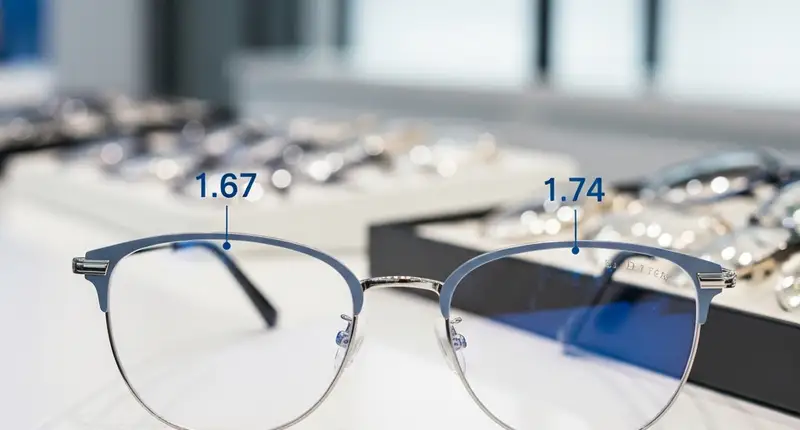
If you are comparing 1.67 and 1.74 high-index lenses in Vietnam, you are probably trying to solve a practical problem: your current lenses feel too thick or too heavy, or they do not look right in the frame you like. Knowing when 1.67 is enough and when it is worth moving up to 1.74 can save you money and make your glasses more comfortable to wear every day.
High index lenses 1.67 1.74 in Vietnam explained
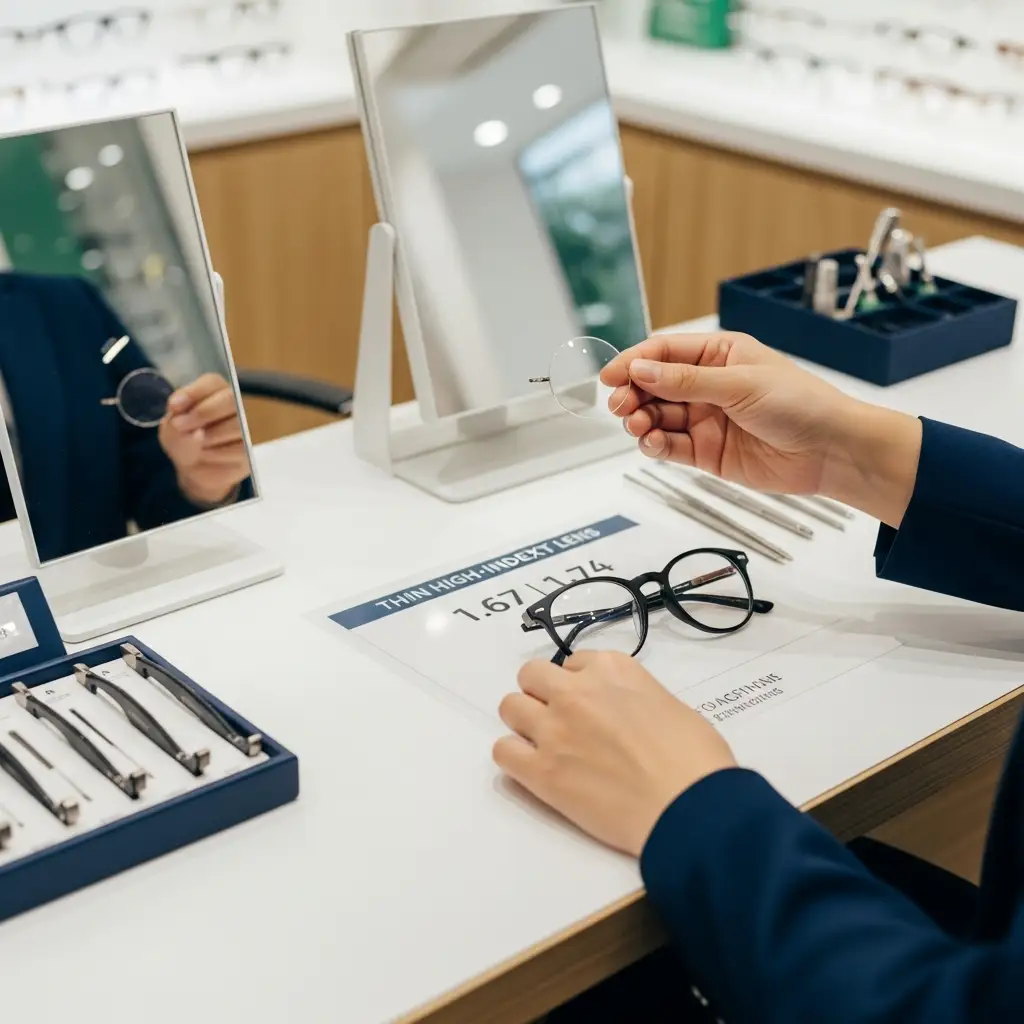
When you shop for thinner lenses, the numbers can be confusing at first. Once you understand what lens index means and how it affects thickness, appearance and price, it becomes much easier to decide which option fits your prescription and your budget.
What high-index lens numbers actually mean
Lens index (refractive index) describes how strongly a lens material bends light. The higher the number, the less material is needed to reach the same prescription, so the lens can be made thinner.
That is why 1.67 and 1.74 lenses are commonly recommended for stronger prescriptions. Compared with standard 1.50 or 1.56 lenses, both can noticeably reduce edge thickness, especially for myopia (short-sightedness).
In simple terms, 1.74 is thinner than 1.67, and 1.67 is thinner than 1.56 or 1.61. But thickness is not the whole story: clarity, reflections, frame size and price also matter.
Why 1.67 and 1.74 are the most compared options
These two indexes are often compared because they cover medium-high to very high prescriptions. If your prescription is mild, you may not need either one.
If your myopia is around -4.00D or stronger, 1.67 is usually among the options an optician will suggest. Once you move into stronger prescriptions such as -7.00D, -8.00D or more, 1.74 comes up more often.
A higher index does not automatically mean a better wearing experience; in many cases 1.67 gives a better balance of thickness, optical quality and cost.
Who should read this Vietnam lens comparison
This guide is for you if you have high myopia, a strong prescription with astigmatism, or you simply want a slimmer, lighter-looking pair of glasses. It is also useful if you are changing frames and want to avoid thick lens edges.
1.67 lens vs 1.74 lens: key differences that matter
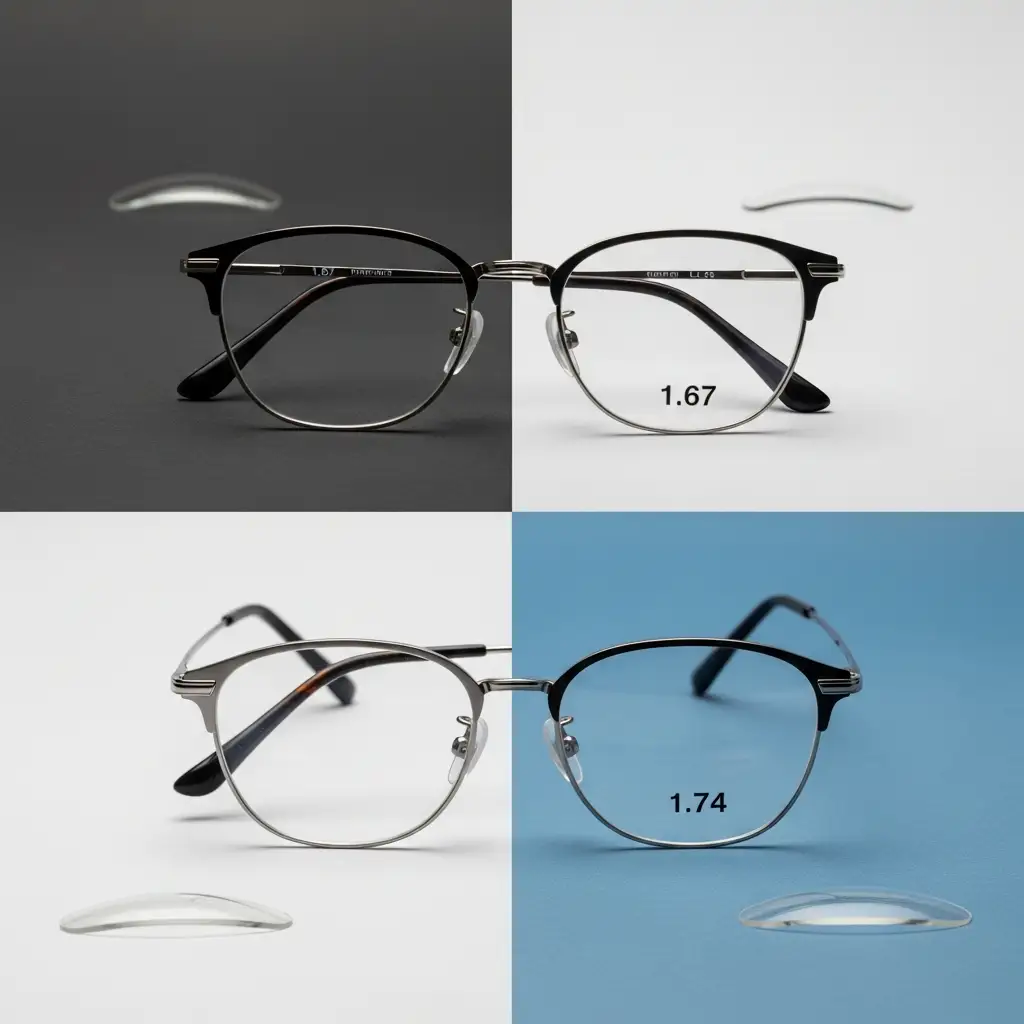
At first glance the difference seems simple: 1.74 is thinner. But when you wear the glasses every day, you notice more than thickness: edge shape, reflections, comfort, adaptation, and how much extra you are paying for each millimetre saved.
Thickness and edge profile in strong prescriptions
For minus lenses, most of the visible thickness sits at the edge. That means frame size and shape can dramatically change how thick your glasses look.
In practice, a 1.74 lens may reduce edge thickness by roughly 5% to 15% compared with 1.67, depending on prescription, lens diameter and frame. For some wearers that difference is clearly visible; for others it only shows when the two lenses are placed side by side.
If you wear around -6.00D in a small round frame, 1.67 may already look very neat. If you wear -9.00D in a larger rectangular frame, 1.74 can make a more meaningful cosmetic difference.
Visual clarity, Abbe value, and chromatic aberration
Higher-index materials usually have a lower Abbe value, which means more chromatic aberration. You may notice slight colour fringing or less comfortable peripheral vision, especially if you are sensitive to it.
This is one reason some people choose 1.67 for daily wear when their prescription allows. The thinner profile of 1.74 is appealing, but the visual trade-off can matter.
Central vision is typically excellent with both; any difference tends to appear towards the edges of the lens. If you are detail-sensitive, discuss this with your optician.
Weight, comfort, and frame balance
Thinner does not always mean dramatically lighter. High-index materials have different densities, and the total weight of your glasses also depends on lens size, frame weight and coatings.
Still, with a strong prescription, reducing edge bulk can improve how the frame sits on your face. That matters if your glasses slide down your nose or feel front-heavy.
Wearers with prescriptions above about -8.00D often find that 1.74 looks cleaner and feels better balanced in light frames. If your frame is already compact, the comfort gain over 1.67 may be modest.
Price differences in Vietnam optical stores
Price is where the decision becomes practical. In Vietnam the jump from 1.67 to 1.74 is often significant, especially with premium anti-reflective coatings or branded lens designs.
The exact gap varies by brand, coating, design and whether the lens is in stock or made to order. In many cases 1.74 costs noticeably more than 1.67.
So do not compare on thickness alone. Ask whether the visual and cosmetic gain is large enough to justify the extra cost for your specific prescription.

Which prescriptions benefit most from each lens index
The right choice depends less on the number printed on the sample card and more on how your actual prescription behaves in your chosen frame. Prescription strength, astigmatism, PD (pupillary distance) and lens diameter all affect the result more than many buyers expect.
When 1.67 is usually enough for daily wear
If your prescription falls roughly between -4.00D and -7.00D, 1.67 is often the practical choice. It is a clear improvement over standard materials without pushing the cost too high.
With a small or medium frame, 1.67 can already give a slim result for everyday wear, especially with an aspheric design. Many people with moderate to fairly high myopia choose 1.67 and never feel they should have paid more for 1.74.
When 1.74 makes more sense for very high myopia
If your prescription is stronger than about -8.00D, especially with astigmatism, 1.74 becomes much more compelling. The edge thickness savings are easier to see and more useful cosmetically.
This is particularly true with rimless, semi-rimless or thin metal frames, where more of the lens edge is exposed. In those frames 1.74 can make the finished pair look noticeably more refined, and it is the range where 1.74 most often earns its premium.
If your prescription differs greatly between the two eyes, a higher index can also reduce the visible difference in thickness between the lenses.
Why frame shape can change the best choice
A large frame can make even a premium lens look thick, while a small frame can make a lower index look surprisingly slim.
That is why frame selection should always be part of the decision. A 48 mm frame can look thinner than a 54 mm frame even when both use the same index.
As a rule, smaller and rounder shapes reduce edge thickness for myopia better than wide rectangular or oversized styles. Before paying more for 1.74, check whether a better frame shape would solve most of the problem.
How thin eyeglass lenses in Vietnam really compare
Most shoppers want a simple answer to which lens is thinner. The reality is more nuanced: lens design, frame measurements and fitting can change the outcome enough that two people with similar prescriptions get very different results.
Why smaller frames can make lenses look thinner
For a minus lens, thickness increases as you move away from the optical centre. The farther the edge sits from your pupil, the thicker that edge becomes.
So a smaller eye size usually helps more than people expect. Reducing frame width by just a few millimetres can make a visible difference.
How aspheric and atoric designs improve appearance
Aspheric lenses have a flatter front curve, which reduces the “bulging” look of strong prescriptions and can slightly reduce how small your eyes look behind the lenses.
Atoric designs go further, especially for strong prescriptions with astigmatism, by improving optics across more of the lens surface.
Many buyers focus only on the index and forget the design. An aspheric 1.67 can sometimes look and perform better than a basic spherical 1.74.
Center thickness and edge thickness explained
For minus lenses the centre is relatively thin and the edge is thicker. For plus lenses (long-sightedness) it is the opposite.
If you are short-sighted, pay attention to the expected edge thickness, not just the index label. Ask the shop to estimate thickness based on your actual prescription and frame.
Two 1.74 lenses from different brands may not look identical either: design, minimum thickness standards and lab processing all affect the finished result.

Tròng kính chiết suất cao 1.67 và 1.74 có gì khác
Nếu bạn đọc bằng tiếng Việt, điều cần biết không chỉ là tròng nào mỏng hơn mà là tròng nào hợp với độ cận, gọng kính và ngân sách của bạn.
Tròng kính chiết suất cao 1.67 phù hợp với ai
Tròng chiết suất 1.67 thường hợp với người cận trung bình đến khá cao, khoảng -4.00D đến -7.00D. Nếu bạn đeo kính cả ngày, làm việc văn phòng hoặc học tập nhiều và muốn cân bằng giữa giá và độ mỏng, đây là lựa chọn rất phổ biến.
Với người nhạy cảm với quang sai màu, tròng 1.67 thường cho cảm giác nhìn dễ chịu hơn 1.74. Giá cũng mềm hơn.
Tròng kính chiết suất cao 1.74 phù hợp với ai
Tròng 1.74 phù hợp hơn khi bạn cận rất cao, thường từ -8.00D trở lên, hoặc muốn ưu tiên thẩm mỹ. Với gọng mảnh, gọng khoan hoặc gọng nửa viền, 1.74 thường đẹp hơn vì mép tròng lộ ra ít hơn.
Tuy nhiên, giá cao hơn rõ rệt, nên 1.74 không phải lúc nào cũng đáng tiền nếu độ cận chưa đủ cao.
Nên chọn tròng 1.67 hay 1.74 theo độ cận
Hãy bắt đầu từ độ cận thực tế. Dưới khoảng -6.00D, nhiều trường hợp 1.67 là đủ đẹp nếu gọng không quá to. Từ -6.00D đến -8.00D là vùng cần cân nhắc kỹ giữa thẩm mỹ và ngân sách. Trên -8.00D, đặc biệt khi có loạn thị hoặc hai mắt chênh độ nhiều, 1.74 thường đáng cân nhắc hơn.
Dù vậy, không nên chốt chỉ bằng độ cận. Hãy xem thêm kích thước gọng và hỏi cửa hàng độ dày mép tròng dự kiến.
Price guide for high index lenses in Vietnam
There is no single fixed price for thin lenses in Vietnam. Prices vary with material, brand, coatings, custom surfacing and the type of shop.
What affects lens pricing in Vietnam
The biggest factors are lens index, brand, coating quality, and whether the lens is in stock or made to order. Imported Japanese, German or Korean brands often cost more than entry-level options.
Prescription complexity also matters. Higher astigmatism, prism correction or a special lens design can raise the price beyond the index itself.
Because of this, prices for what looks like the “same” lens can differ a lot between shops. Compare brand, coating package, warranty and design, not just the quoted number.
As a reference, our current catalogue lists thin high-index lenses (1.60, 1.67 and 1.74) from around 308,000₫ to 6,240,000₫ per pair, depending on brand, index and coating. Prices change, so check the high-index lens category for current figures.
Coatings that add value and cost
A good anti-reflective (AR) coating is especially important on 1.67 and 1.74 lenses, because higher-index materials reflect more light. Without it, your lenses look shinier and can be less comfortable in bright light.
Water-repellent, oil-repellent and anti-smudge layers add cost, but many wearers find them worthwhile in a humid, dusty climate. Scratch resistance and UV protection are often bundled, though not always to the same standard.
When premium 1.74 is worth paying for
Paying more for 1.74 makes sense when the reduction in visible thickness is meaningful for your frame and prescription: very high myopia, frames that expose the lens edge, or when appearance is a top priority.
The premium is also easier to justify if you wear your glasses full-time, 10 to 14 hours a day. If the benefit is slight, 1.67 usually gives better overall value.
How to compare quotes from optical shops
Ask each shop the same questions: lens brand, actual index, lens design, coating type, warranty, and estimated edge thickness in your chosen frame.
If a shop cannot explain these clearly, be cautious. Judge a high-index lens by the finished result, not by the sales pitch.

Best coatings and add-ons for high myopia lenses
Once you have chosen the index, the coating package matters more than many people realise. For strong prescriptions, the right coatings improve how the lenses look, reduce glare, and make cleaning easier.
Anti-reflective coatings for clearer appearance
High-index lenses reflect more surface light than lower-index lenses, so with a poor AR coating other people see more reflection and less of your eyes.
A quality anti-reflective layer improves appearance and reduces distracting reflections from screens, headlights and indoor lighting. As Wikipedia notes, higher-index materials benefit strongly from anti-reflective treatment.
If you choose 1.74, treat a good AR coating as essential rather than optional.
UV, water-repellent, and smudge-resistant options
UV protection is worth having, especially if you spend time outdoors. Water-repellent and oil-resistant coatings help in hot, humid weather when lenses get dirty quickly.
If you wear glasses all day, an easy-clean coating often makes a bigger daily difference than people expect.
Blue light filtering: useful or overhyped
Blue light filtering is optional: Essilor notes there is not yet enough research to confirm that blue-light filtering glasses reduce eye strain, and the American Academy of Ophthalmology links screen discomfort to long screen time and reduced blinking, not to blue light.
If screen glare bothers you, a good AR coating and sensible screen habits may help more. Treat a blue filter as a personal add-on, not a requirement, and do not let add-ons distract from the basics: the right lens design and a good fit.
Lens design upgrades for stronger prescriptions
For strong myopia, aspheric or atoric designs are often worth more than buyers expect. They improve edge appearance, reduce lens bulge and give a better cosmetic result.
When you compare 1.67 and 1.74 offers, ask whether each lens is spherical, aspheric or atoric. That one detail can change both looks and comfort.
Common buying mistakes when choosing thinner lenses
Disappointment usually comes not from the wrong brand but from focusing on the wrong factor. Many buyers pay for a premium index and are still unhappy because frame choice, measurements and adaptation were ignored.
Choosing lens index without considering frame size
This is the most common mistake: you buy the highest index available, but the frame is too large, so the edges still look thick.
A smaller frame often gives a better result than simply upgrading the index. If your optician never mentions frame size, that is a warning sign.
Paying more for 1.74 without real benefit
If your prescription is moderate and your frame is compact, 1.74 may offer only a small cosmetic gain. The extra money may be better spent on a good coating or a better lens design.
Ignoring comfort and visual adaptation factors
Some wearers adapt immediately; others are more sensitive to peripheral distortion or colour fringing. If you are sensitive, the thinnest option may not feel the best.
The lens that wins on paper does not always win in daily wear.
How to choose the right lens with your optician
The best decision comes from combining your prescription, frame, visual sensitivity and budget in one conversation. A good optician should help you compare realistic outcomes, not just push the highest index on the shelf.
Questions to ask before ordering lenses
Ask what edge thickness to expect in your frame, whether the lens is aspheric or atoric, which coating is included, and whether 1.67 would already be sufficient.
What measurements affect final lens thickness
Prescription strength is only part of the equation. PD, fitting height, frame eye size, bridge width, lens diameter and decentration all affect thickness.
Even a few millimetres of decentration can add edge bulk, which is why accurate measurements matter when ordering high-index lenses.
A simple checklist for choosing 1.67 or 1.74
Choose 1.67 if your prescription is moderate to fairly strong, your frame is not oversized, and you want good value. Choose 1.74 if your myopia is very high, your frame exposes the lens edge, or you want the thinnest possible look and accept the higher cost.
If you are unsure, ask the shop to compare the estimated finished thickness of both options in the same frame. That is usually the fastest way to decide.
Buying 1.67 and 1.74 lenses at Mắt Kính Đặng Phước Quân in Da Lat
Mắt Kính Đặng Phước Quân is an optical store at 31 Nguyễn Văn Cừ, Phường Xuân Hương, Đà Lạt, open daily 09:00–21:00 and in business since 1991. Eye tests are free and walk-in, no appointment needed; see our eye test guide. We carry high-index lenses from Essilor, Chemi, Kodak, Hoya and Nikon, and ZEISS lenses can be ordered to prescription.
Single-vision lenses that are in stock are usually fitted in about 20–40 minutes, depending on prescription and lens type. Some 1.67 and 1.74 lenses, especially with very high prescriptions, astigmatism or special coatings, need to be ordered. To check first, send a photo of your prescription by Zalo or WhatsApp to +84 925 331 668. More on prescription glasses in Da Lat.
FAQ
Is 1.74 always better than 1.67 for high myopia?
No. 1.74 is thinner, but not automatically better. If your prescription already looks good in 1.67 in your chosen frame, 1.67 may give you better value, good clarity and easier adaptation.
What is the difference between 1.67 lens vs 1.74 lens in daily use?
The main differences are edge thickness, reflections, price and sometimes peripheral comfort. 1.74 is usually thinner, but it may reflect more light and cost noticeably more, so the practical benefit depends on your prescription and frame.
Nên chọn tròng 1.67 hay 1.74?
Nếu độ cận chưa quá cao và gọng nhỏ hoặc vừa, 1.67 thường là lựa chọn hợp lý. Nếu cận rất cao, muốn kính mỏng tối đa hoặc dùng gọng lộ mép tròng, 1.74 thường phù hợp hơn.
Are high-index lenses in Vietnam worth the price?
Yes, if you have a strong prescription and want thinner, lighter-looking glasses. If your prescription is moderate, you may not need the highest index; a good 1.67 lens with a better coating is often the better purchase.
How much are thin eyeglass lenses in Vietnam?
It depends on index, brand, coatings and the shop. 1.67 is usually mid-range to upper mid-range, while 1.74 sits higher, especially with a premium coating and an aspheric or custom design. In our catalogue, thin high-index lenses currently range from around 308,000₫ to 6,240,000₫ per pair; prices may change.
Do 1.74 high-index lenses have more glare?
They can. Higher-index materials reflect more light, which is why a high-quality anti-reflective coating is especially important if you choose 1.74.
If you are still deciding, the simplest next step is to bring your prescription to an optician, choose your frame first, and ask for a thickness estimate with both options. For many people, that one comparison makes the choice between 1.67 and 1.74 clear.
More
Need to ask before an eye test?
Message us on WhatsApp or Zalo, and the store will answer for your case.